
As industrial projects become more complex and timelines grow tighter, choosing the right design approach is critical. One of the most common decisions companies face is whether to rely on traditional 2D drafting or invest in advanced 3D modeling services. Both play an important role in engineering, but understanding when to use each can significantly impact project cost, efficiency, and overall success.
At its core, 2D drafting is the foundation of engineering documentation. It involves creating detailed technical drawings such as plans, elevations, schematics, and piping and instrumentation diagrams (P&IDs). These drawings are essential for fabrication, construction, and regulatory approvals. In many cases, engineering drafting services focused on 2D outputs remain the most efficient and practical solution, particularly for straightforward systems or well-defined scopes.
However, as projects scale in complexity, the limitations of 2D become more apparent.
This is where 3D modeling in engineering provides a significant advantage. Unlike static drawings, 3D models create a spatial, data-rich representation of a facility. These models allow teams to visualize systems in context, identify clashes between disciplines, and optimize layouts before construction begins. For large industrial projects, this level of visibility can dramatically reduce rework and improve coordination.
2D drafting is best suited for projects where scope is clearly defined and complexity is manageable. It is commonly used for:
Because 2D drawings are faster to produce and require less upfront investment, they are often the most cost-effective option for smaller or well-understood projects.
For more complex or high-risk projects, 3D modeling for engineering becomes essential. This includes:
By using advanced 3D modeling services, teams can work from a single, accurate source of truth. This improves collaboration, reduces uncertainty, and allows for better decision-making throughout the project lifecycle. (Also check out our blog on 3D modelling vs Digital Twins here)
The Role of 3D Laser Scanning
For existing facilities, accurate data is the foundation of any successful 3D model. This is where 3D laser scanning services (also known as industrial 3D scanning services) play a critical role.
Laser scanning captures millions of data points from real-world environments, enabling the creation of highly accurate digital representations. These scans are then used to build a precise industrial 3D model, ensuring that design work reflects actual site conditions.
In brownfield projects, this is especially important. Outdated drawings are one of the leading causes of design conflicts and field rework. By combining scanning with 3D modeling for engineering, teams can significantly reduce risk and avoid costly surprises during construction.
In reality, most industrial projects benefit from a combination of both 2D and 3D design. While 3D models are ideal for coordination and visualization, 2D drawings are still required for fabrication, installation, and documentation.
The most effective workflows integrate both:
This hybrid approach allows companies to balance cost and efficiency while maintaining accuracy across all project phases.
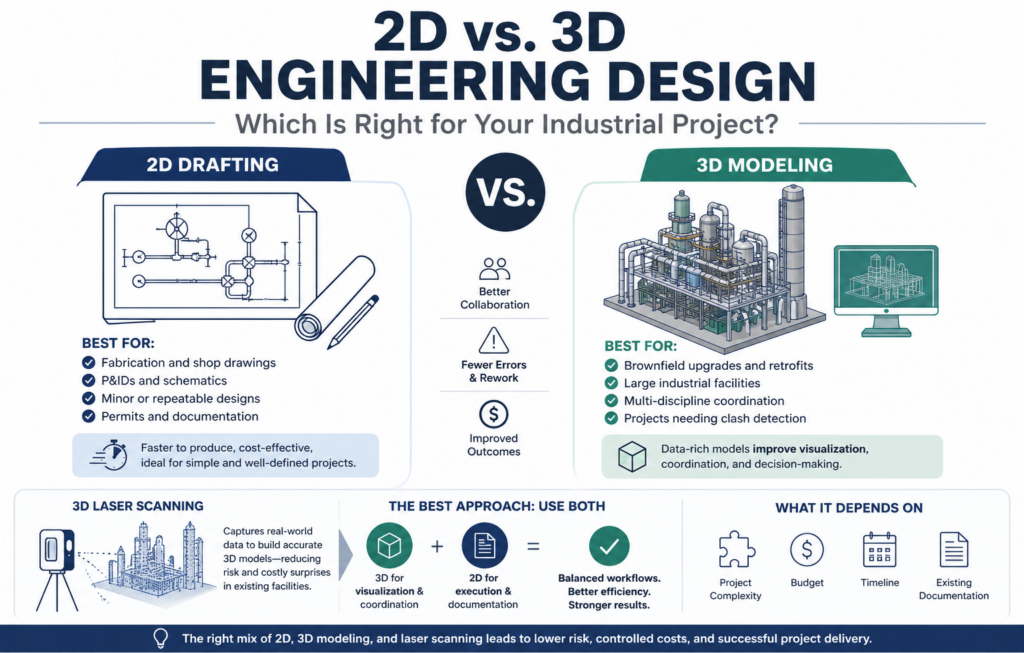
Selecting between 2D and 3D design depends on several factors, including project complexity, budget, timeline, and the condition of existing documentation. Simpler projects may not require full 3D modeling, while complex facilities can benefit significantly from the added visibility and coordination it provides.
Prozus supports both approaches through scalable engineering drafting services and advanced 3D modeling services. Whether clients need high-quality 2D documentation, detailed 3D models, or a combination of both, Prozus delivers solutions tailored to the specific needs of each project.
By aligning the right tools with the right project, companies can reduce risk, control costs, and improve overall project outcomes. In today’s industrial landscape, understanding when to use 2D vs. 3D design is not just a technical decision – it’s a strategic advantage.