
Industry: Real Estate Asset Management
Location: Calgary, AB Canada
Scope : Discovery & information architecture, SharePoint site build, AI metadata extraction, file migration & quality control
Software: Microsoft SharePoint (M365), SharePoint API integration, proprietary AI scanner/categorization tool
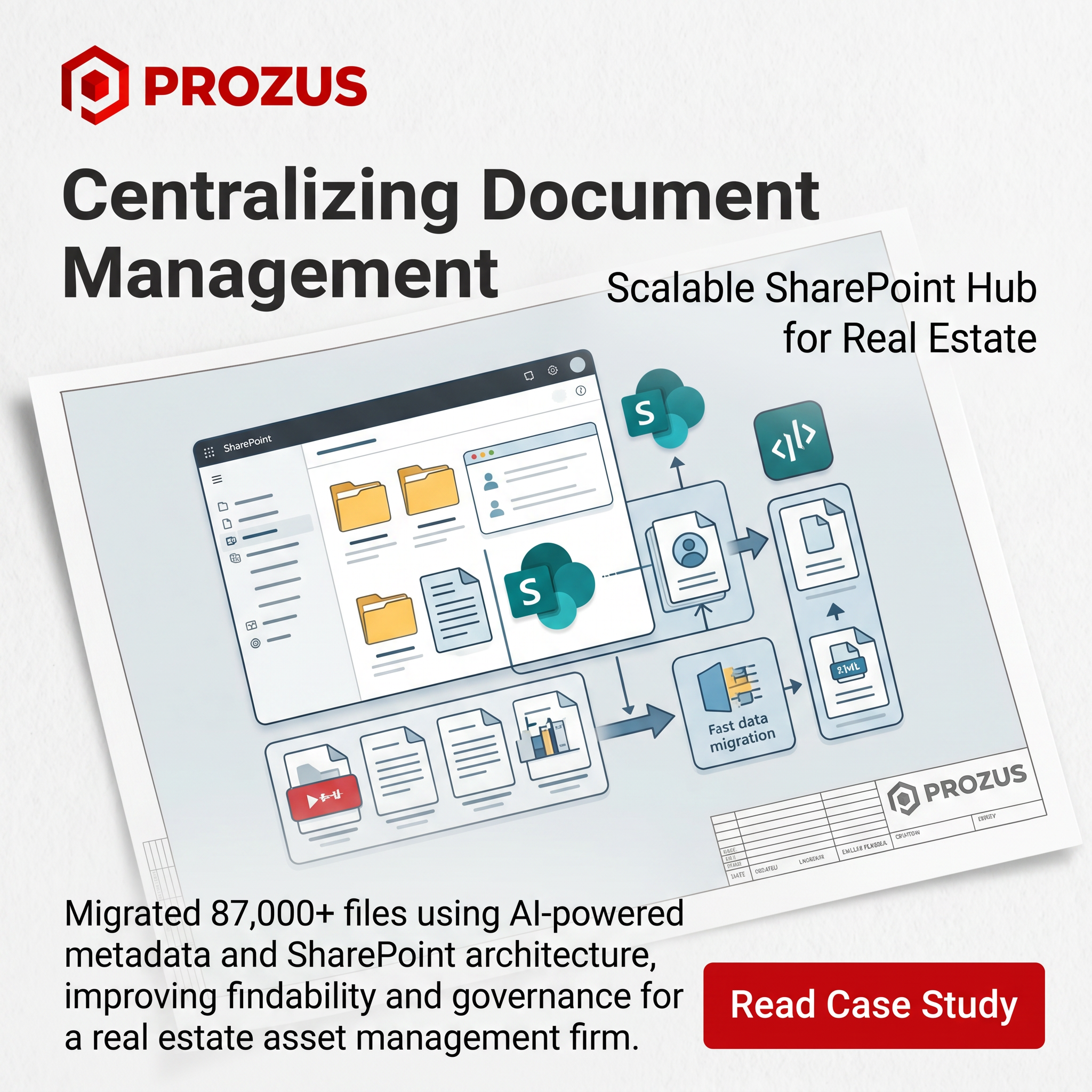
Documents were everywhere – answers were not.
Like many fast‑growing organizations, The client’s teams relied on shared drives and scattered digital sources to store critical records. Over time, file sprawl made it increasingly difficult to locate the right document quickly—and to trust that it was the most current version.
Without consistent structure and metadata, everyday work (from property management to finance) was slowed by manual searching, duplicated effort, and inconsistent filing practices. The client needed a modern, scalable document management foundation—not just a one‑time move of files.
· Limited findability due to inconsistent naming, foldering, and missing metadata
· High manual effort to classify documents and maintain consistency over time
· Need for governance-ready structure to support long-term operational use
· A solution that could scale beyond a pilot to departmental rollouts
prove the integrity of the design.
The Goal: Deliver Accurate, Editable, and Fully Compliant 3D Models and Detailed Manufacturing Drawings
The client aimed to:
• Have accurate 3D models in Autodesk Inventor Pro that allowed future editing
• Hade detailed fabrication-ready drawings to support the redesign
• Have the drawings P.Eng. stamped for regulatory compliance and to prove the design integrity
The Objective
Prove the system, then scale it.
The client set out to create a SharePoint-based document hub that would make files easy to find, easy to manage, and easy to govern. The strategy was to start with a Proof of Concept (PoC) that validated information architecture, metadata standards, and automation – then expand into a full migration program.
· Design an intuitive SharePoint file structure aligned to the client’s business needs
· Define a practical metadata schema (including a standardized list of file types)
· Use AI-assisted metadata extraction to accelerate classification
· Validate accuracy through quality control (QC) and client review
· Establish a repeatable migration pipeline for broader rollout
A partner that blends SharePoint build, AI automation, and document-control discipline
The client chose Prozus for our ability to deliver more than a technical migration. We combined SharePoint architecture, automation, and rigorous QC to create a system that teams could use and sustain. Our proprietary scanner/categorization capability accelerated metadata tagging while our QA process protected accuracy and reliability.
Phase 1: Discovery & Proof of Concept (PoC)
The PoC focused on building the foundation and proving it at a real scale. We migrated an initial 10,000 files into SharePoint, applying metadata to each file, and validating the workflow end-to-end.
· Conducted stakeholder discovery to understand file types, usage patterns, and success criteria
· Proposed and implemented SharePoint libraries for Property Management and Finance
· Defined a metadata schema and standardized dropdown list of file types
· Configured the proprietary scanner/categorization tool and tested it on sample content
· Processed and migrated 10,000 files with metadata applied in SharePoint
· Performed QC checks to verify metadata accuracy and structural integrity
· Delivered training documentation to support adoption and self-sufficiency
Phase 2: Full Migration & AI Metadata at Scale
Following the PoC success, the initiative expanded into a full migration program for Property Management and Finance content. This phase industrialized the pipeline combining AI metadata extraction, SharePoint API integration, and structured QC and review cycles.
· Collected and prepared departmental documents for processing, including archive identification
· Enhanced the SharePoint migration pipeline and integrated SharePoint APIs for smooth ingestion
· Applied AI-assisted categorization and metadata extraction across large batches
· Segregated duplicates and archives early to streamline processing and reduce effort
· Validated outputs with QC and incorporated client feedback during the review window
· Optimized the workflow iteratively for speed, consistency, and scalabilit
A scalable SharePoint foundation – proven with 10,000 files and ready for enterprise rollout
The PoC delivered immediate impact: The client gained a structured SharePoint environment with defined metadata and a proven migration workflow. Teams could now locate documents faster and more reliably, with consistent tagging that supports search, filters, and governance.
With the pipeline validated, The client moved into a production-scale program to process 87,375 files across document types including scanned PDFs, duplicates, and archives using AI-driven extraction backed by human QC.
· 10,000 files successfully migrated and tagged during the PoC, validating the approach
· SharePoint libraries and a practical metadata model established for long-term use
· AI-assisted tagging accelerated classification while QC protected data quality
· A repeatable, batch-based process created for processing 87,375 files at scale
· Clear training documentation and governance-ready structure supported adoption
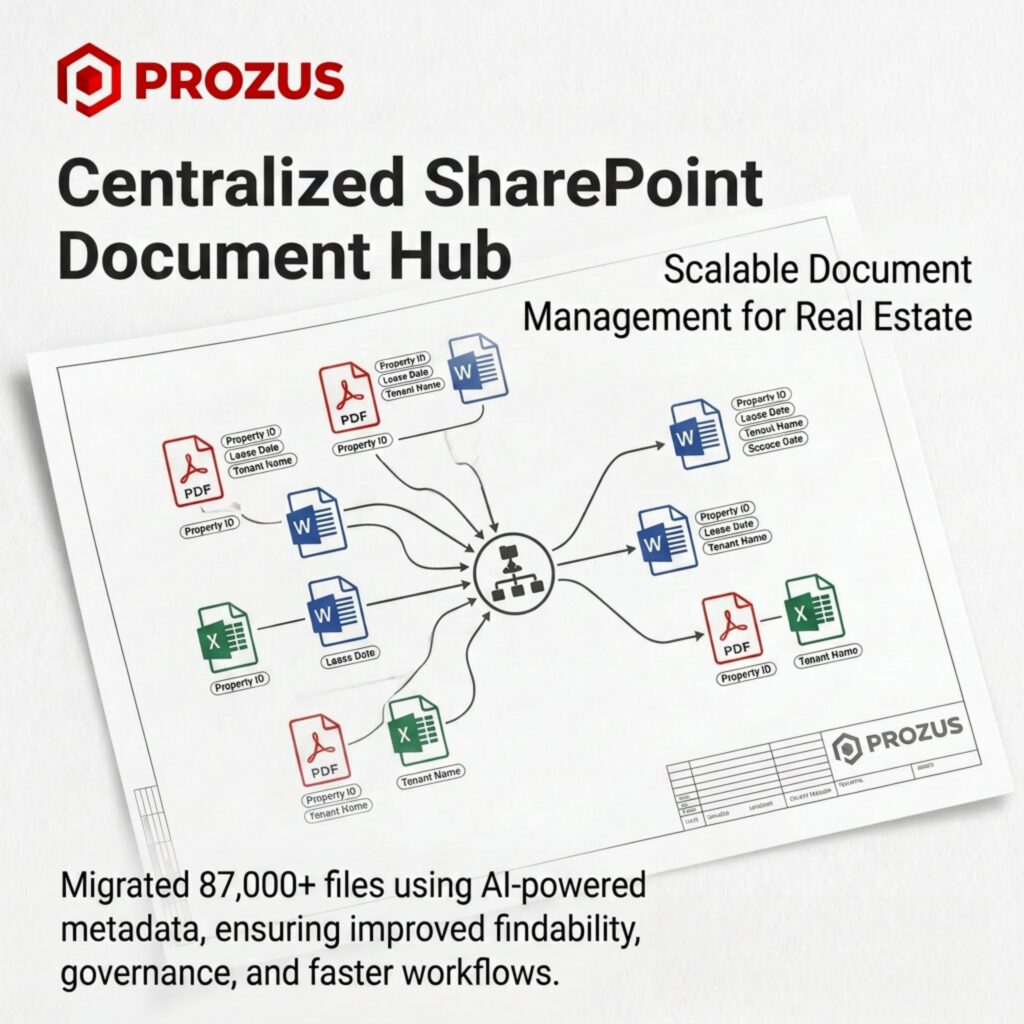
One-time foundation work that compounds across business units
Many of the PoC deliverables information architecture, metadata standards, tool configuration, and training are reusable. That means each additional department benefits from faster onboarding, consistent governance, and lower incremental effort.
Automation that scales – quality that lasts
Successful migrations aren’t measured by how many files move; they’re measured by whether people can find and trust what they need afterward. By pairing AI-powered metadata extraction with disciplined QC and SharePoint-native design, Prozus helped the client turn digital clutter into an organized, searchable knowledge base—ready to support day-to-day operations and future growth.