
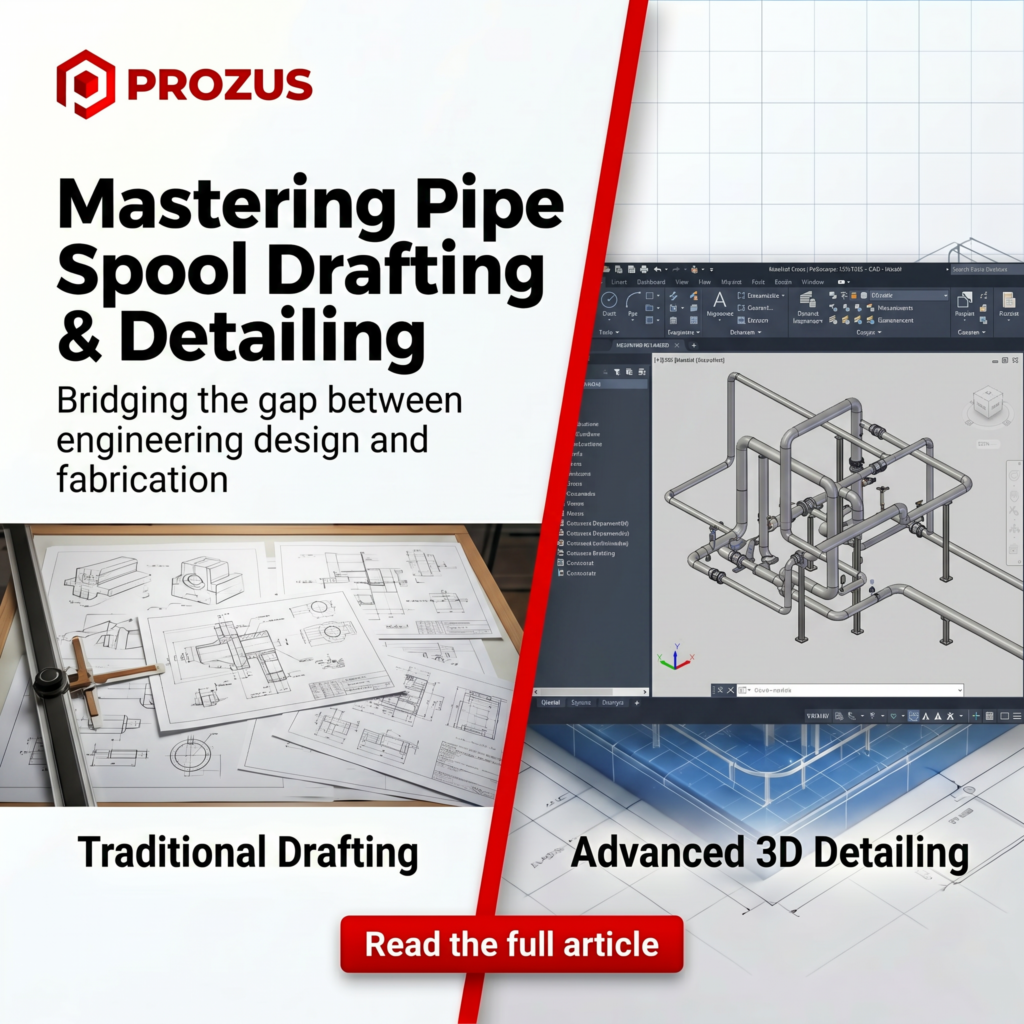
Before a single pipe spool is cut, beveled, or welded, every dimension, connection, and weld joint must be clearly defined. Pipe spool drafting and detailing transforms complex piping designs into precise, fabrication-ready instructions that drive efficiency from the shop floor to final installation.
In modern industrial projects, accurate piping spool detailing ensures that engineering, fabrication, and construction teams remain fully aligned – reducing errors, minimizing rework, and improving overall project delivery.
Pipe spool drafting is the process of extracting fabrication-ready drawings from piping isometrics, P&IDs, and 3D plant models. These spool fabrication drawings act as the critical link between design and execution.
Through piping spool drafting, engineers define:
In large-scale facilities such as refineries, LNG plants, and process industries, even minor dimensional mismatches can lead to fit-up issues, costly field rework, and schedule delays.
What Does Spool Detailing Include?
In practice, pipe spool detailing services cover a range of specialized deliverables essential for fabrication and installation:
These deliverables ensure full traceability, clarity, and alignment across engineering, fabrication, and site teams.
Effective piping spool detailing goes beyond drafting – it requires strategic planning for constructability.
Breaking a piping system into transportable, fabrication-friendly spools depends on:
A well-planned spooling strategy maximizes shop fabrication while minimizing field welding. This not only improves quality control but can significantly reduce installation time and field rework.
Many EPC contractors today partner with specialized providers like Prozus to optimize spool segmentation and improve delivery timelines through scalable execution models.
Dimensional accuracy is at the core of successful pipe spool drafting.
Detailing teams must account for:
This becomes especially critical in high-pressure and high-temperature systems, where even small deviations can compromise system integrity and performance.
Accurate spool drawings can significantly reduce rework and improve fabrication and installation efficiency across the project lifecycle.
Traditional 2D spool drawings remain the primary fabrication reference, even when generated from intelligent 3D models.
However, 3D tools such as:
enhance piping engineering workflows by enabling:
By integrating BIM-based workflows, project teams can identify and resolve interferences before fabrication begins – reducing costly downstream issues.
Accurate spool fabrication drawings directly impact:
Errors in spool detailing can lead to:
In modular construction environments, where prefabrication is critical, inaccurate spool drawings can disrupt entire installation workflows.
Maintaining alignment between design drawings and actual site conditions is essential.
During execution:
Updating spool drawings to reflect as-built conditions ensures accurate documentation for:
In brownfield projects, mismatches between design and site conditions are a major source of inefficiency—making accurate spool updates critical.
Pipe spool drafting plays a key role in ensuring compliance with industry standards such as:
Accurate detailing supports:
This level of documentation is essential for audit readiness and regulatory compliance in industrial projects.
Prozus provides comprehensive pipe spool drafting and detailing services tailored to industrial projects, including:
By leveraging a global delivery model and standardized workflows, Prozus supports high-volume project requirements with fast turnaround times and consistent quality.
Unlike traditional hourly billing models, Prozus offers fixed-price structures based on complexity – providing greater cost predictability for EPC contractors and project owners.
Pipe spool drafting and detailing is a critical component of modern industrial project execution. It enables precision, improves constructability, reduces risk, and enhances fabrication efficiency.
As projects grow more complex and timelines tighten, the demand for accurate, scalable piping spool detailing services continues to rise. When executed correctly, spool drafting becomes a key driver of project success – from initial design through to final installation.