
Every few months another tool shows up promising to “automate” engineering drafting, and every few months a
drafting team somewhere tries it, gets excited for about a week, and then quietly goes back to doing the work
the way they always have just with one new tab open for the parts it’s actually good at. That’s roughly where
things stand right now with AI Engineering Drafting. Not hype, not nothing. Somewhere in between, and worth
being specific about.
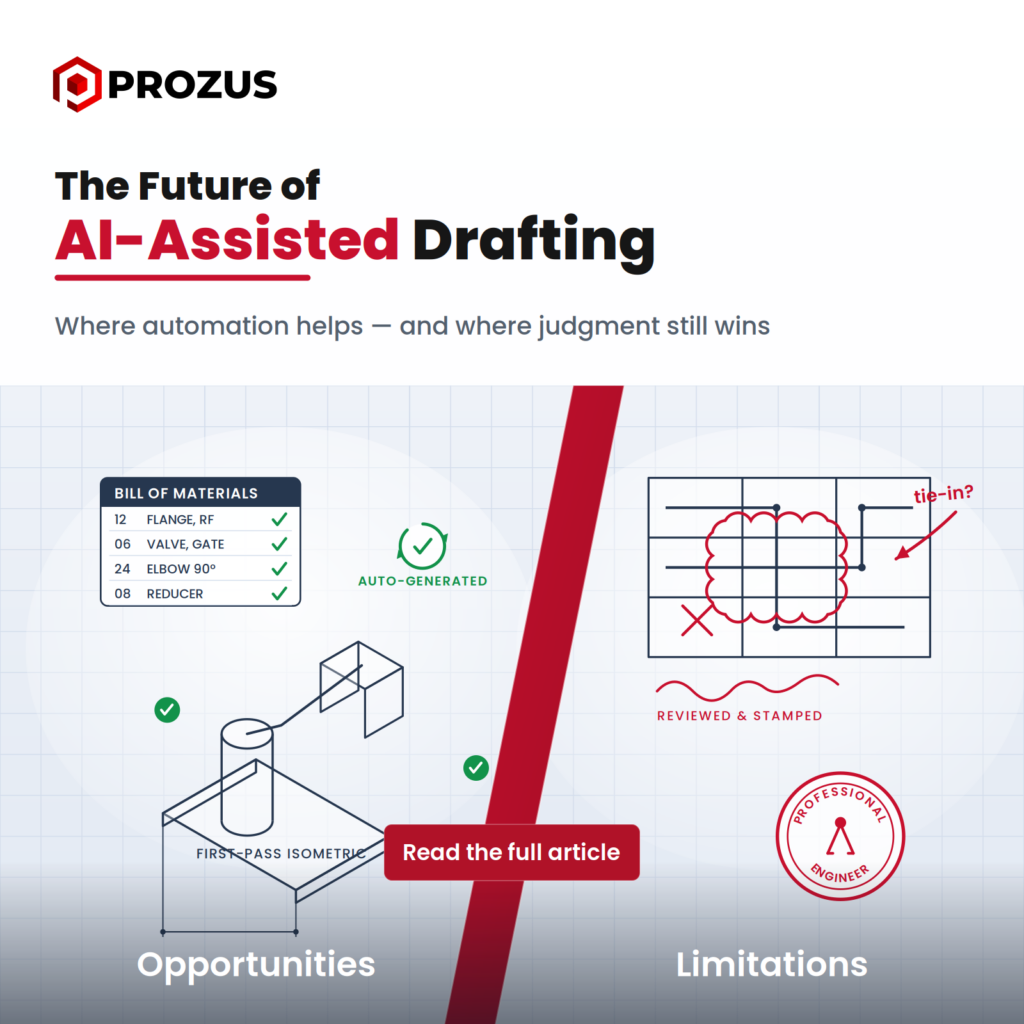
The clearest wins so far aren’t glamorous. They’re the repetitive, rules-based parts of drafting that used to eat
hours without requiring much judgment. Generating bills of materials from a model. Checking a drawing set for
missing tags or inconsistent callouts. Converting scanned legacy drawings into editable CAD files. Cleaning up line
weights and layer standards across a batch of files instead of doing it one drawing at a time.
This is where Artificial Intelligence in Engineering earns its keep not by designing anything, but by handling the
tedious verification and cleanup work that drafters have always done manually because nobody had a better
option. A lot of the genuinely useful Automated Drafting Solutions on the market today are really just very good
pattern-matching and rule-checking tools wearing an AI label. That’s not a knock on them. Pattern-matching at
scale, applied to thousands of line items or hundreds of similar drawings, is exactly where this technology is
currently strongest.
CAD Automation Tools have also gotten noticeably better at the in-between tasks auto-routing simple piping
runs, generating isometrics from 3D models, flagging clashes before they reach the field. These don’t replace a
piping engineer’s judgment about why a route should go a certain way, but they cut down the hours spent manually
drawing what the model already implies.
Here’s the part that doesn’t get said enough: Engineering Design Automation still struggles badly with anything that
requires context the software doesn’t have. A tool can check that a drawing follows your title block standard. It
has a much harder time knowing that the client’s site has a quirky tie-in requirement from a 2014 modification that
isn’t documented anywhere a model could read it.
AI tools are also only as good as the data they’re trained on and the inputs they’re given. Feed a drafting AI a
messy, inconsistent set of legacy drawings and ask it to extrapolate standards from them, and it will confidently
produce something that looks clean and is subtly wrong in ways that take a trained eye to catch. That’s a
meaningfully worse outcome than an obviously bad output, because it’s the kind of mistake that slips through review.
There’s also the regulatory and liability reality that doesn’t get much attention in the demo videos. A stamped
drawing carries a professional’s signature and legal responsibility behind it. No AI tool changes that a licensed
engineer still has to review, understand, and stand behind the work, which means the time saved on generating a
drawing doesn’t always translate into time saved on the project, because the checking still has to happen, and
arguably has to happen more carefully when part of the process was automated.
And plenty of real industrial drafting work simply isn’t repetitive enough to automate well. A one-off structural
detail for an unusual load case, a piping layout that has to thread through an existing congested rack, a P&ID
update that depends on understanding why a previous engineer made a specific design choice these still need
a person who actually understands the project, not just the geometry
Looking at broader Engineering Technology Trends, the pattern that seems durable isn’t “AI replaces drafters.” It’s
AI absorbing the lowest-judgment, highest-repetition parts of the workload, while the actual drafting and design
work shifts toward review, coordination, and the parts of the job that require knowing the client’s facility, not just
the CAD software. Firms that figure out how to use these tools for what they’re good at checking, converting,
generating first-pass geometry and keep skilled people on what they’re good at judgment, context, sign-off are going to move faster than firms doing everything manually, without losing the accuracy that actually
matters in an industrial setting
We’ve taken a pretty deliberate stance on this: use AI where it removes drudgery, keep people firmly in charge
of anything that requires judgment or carries engineering responsibility.
A concrete example is our document digitization work. When clients hand us boxes of legacy paper drawings, we
don’t just scan them we use AI to help categorize and tag the resulting files into a searchable system, so years
of Facility Engineering Records that used to live in a filing cabinet become something a client’s team can actually
search through by equipment, area, or revision. That’s a task that’s tedious and repetitive enough for AI to genuinely
help, and low-risk enough that a wrong category gets fixed in seconds rather than causing a field problem.
On the drafting side, we use automation for the parts of the process where it’s proven reliable generating first pass isometrics from 3D models, checking drawing sets against client standards before they go out, batch-cleaning
legacy files during a digitization project. But every drawing we deliver still goes through our standard quality
checks by our drafting and engineering staff, and anything requiring a professional stamp goes through a licensed
engineer the same way it always has. We’re not interested in shipping a faster drawing that’s wrong we’re
interested in shipping the same accuracy our clients expect, with less of the manual grind behind it.
The honest version of where this is headed: AI Engineering Drafting tools are going to keep getting better at the
repetitive 60% of the job, and that’s genuinely useful. But the 40% that requires understanding a real facility, a
real client’s history, and real engineering judgment isn’t going anywhere and any firm telling you otherwise is
probably trying to sell you something.