
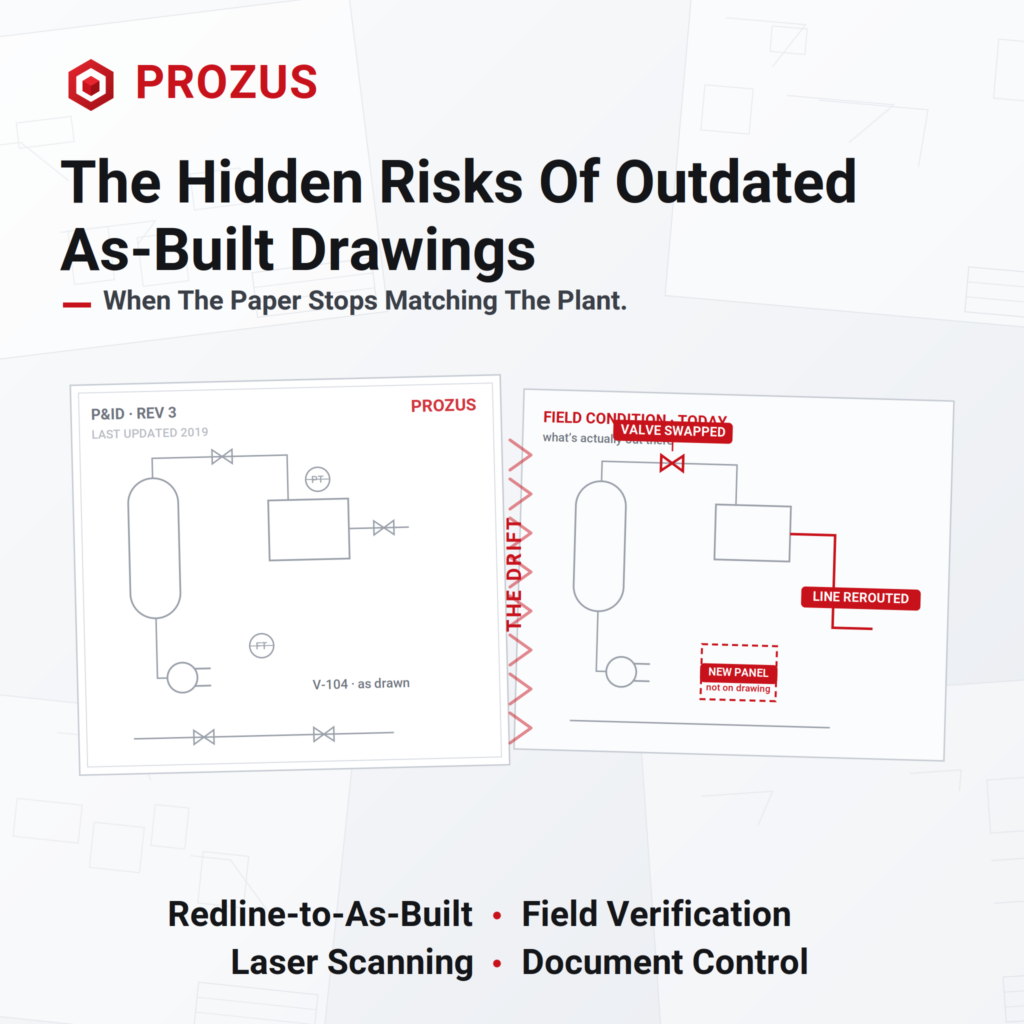
Walk into almost any plant file room and you’ll find the same quiet assumption baked into how things run: the drawings on file match what’s actually out there on the floor. Ask anyone who’s worked a turnaround, though, and they’ll tell you that’s rarely true for long.
A valve gets swapped out during an emergency repair at 2 a.m. A contractor reroutes a line around a piece of
equipment that wasn’t there last year. Someone upgrades a control panel and means to update the schematic later, except later never quite comes. None of these are dramatic moments on their own. But they’re exactly how As-Built Drawings slowly stop reflecting reality, and that gap between paper and plant is where the real risk
hides.
Nobody sets out to let documentation fall behind. It just tends to lose every priority fight. A maintenance crew
finishing an emergency job isn’t thinking about redlines they’re thinking about getting the unit back online. A
contractor wraps up a tie-in and moves on to the next site. Multiply that by a few years of normal operations,
Engineering Drawing Updates stop being a routine task and start being a backlog nobody wants to own.
It’s also rarely just one drawing. Industrial Facility Documentation is a web of P&IDs, isometrics, electrical
schematics, plot plans, equipment data sheets, all referencing each other. Change one pipe spec in the field and
forget to update it, and now three or four documents are quietly wrong, each one looking perfectly official
This kind of drift doesn’t usually announce itself with one big failure. More often it shows up as a string of smaller,
expensive problems: A technician isolates the valve the drawing says is correct, except the actual configuration changed two years ago and nobody updated the file. That’s not a paperwork issue anymore that’s a lockout/tagout
failure waiting to happen.
An engineer planning an expansion starts designing off a drawing set that doesn’t match current conditions,
and the clash isn’t discovered until construction, when it’s ten times more expensive to fix than it would have
been on paper.
An audit turns up documentation that doesn’t match the field, and now you’re explaining the gap to a
regulator or an insurer instead of just operating the plant.
Maintenance planning, spare parts decisions, capital project scoping all of it depends on Plant Asset
Management built on documentation that’s actually accurate. When the drawings are wrong, every
decision built on top of them inherits that error, usually without anyone realizing it until something doesn’t
fit.
And there’s a slower risk too: the senior operator who’s been there twenty years and just knows how the
plant really looks. That knowledge isn’t written down anywhere. When they retire, the inaccurate drawing
set becomes the only record left.
Most facilities aren’t failing here because people aren’t trying. They’re failing because there’s no real process for closing the loop. Someone marks up a drawing in the field, that markup gets mentioned in a meeting, and then it just sits. Without actual Engineering Change Management, that’s the default outcome.
The facilities that get this right usually have a few things in common: they capture changes at the source instead of relying on memory, they have a defined cadence for actually turning redlines into finished drawings rather than leaving it to whenever someone has spare time, they verify against the field instead of assuming the markup was complete, and they keep everything in a single version-controlled location so nobody’s working off last year’s revision by accident
This is more or less the exact problem we built our drafting practice around. Most clients don’t come to us wanting new drawings for their own sake they come to us because the documentation has fallen behind the facility, and pulling their own engineers off real project work to fix it isn’t realistic.
In practice, that looks like a handful of recurring jobs. A lot of it is straightforward redline-to-as-built conversion clients hand us a stack of field markups, sometimes clean, sometimes years of accumulated turnaround notes, and we turn them into finished, standards-compliant P&IDs, isometrics, and electrical schematics. When the redlines aren’t trustworthy enough on their own, we’ll run a field verification or laser scan to capture the facility as it actually exists and update or rebuild the drawing set from that.
We also do a fair amount of plain document rescue work: boxes of legacy paper drawings that get scanned,
digitized, and organized into a searchable system so the Facility Engineering Records are something people can actually find, instead of something that lives in a filing cabinet nobody opens. And for clients who want to stop the backlog from forming again, we help set up the document control and revision workflows that keep Engineering Change Management functioning after we’ve finished the initial catch-up. For some clients, the relationship just becomes ongoing we sit alongside their team handling routine drawing
updates as changes happen in the field, on a fixed-price basis, so the documentation stays current instead of
slowly drifting again over the next two years.
That fixed-price model matters more than it might sound like. A lot of these projects get put off precisely because nobody wants to sign up for open-ended hourly billing on something that feels like it could spiral. Knowing the cost upfront tends to be what actually gets the project started.
Outdated as-built drawings don’t fail loudly they fail in slow, expensive, hard-to-trace ways: a few extra
weeks on a project here, a near-miss during maintenance there, a bad capital decision made on bad information.
The facilities that handle this well don’t treat documentation as a one-time cleanup. They treat it as something that has to be maintained, whether that’s built in-house or handled by a partner.
If it’s been a while since your drawings actually matched your plant, you’re far from alone but it’s worth closing that gap before it costs you more than the drafting hours ever would