
Industry: Oil & Gas / Pipeline Infrastructure
Location: Alberta & British Columbia, Canada
Scope: As-Built 3D Modeling & Intelligent Model Development
Software: AutoCAD Plant 3D, Navisworks
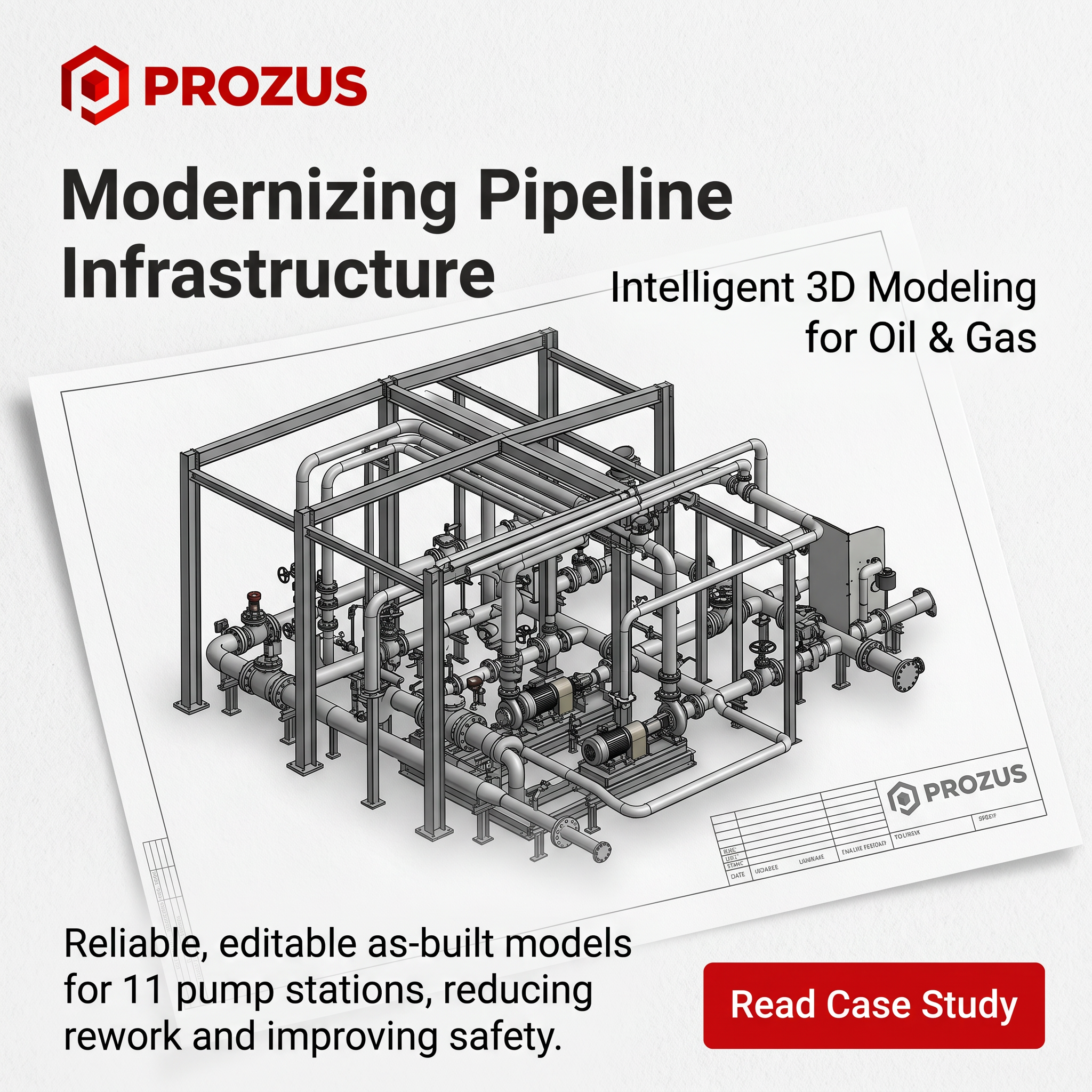
As a critical owner and operator of pipeline infrastructure, the client depends on accurate, reliable facility data to support safe operations, maintenance planning, and regulatory compliance. However, many pumpstation facilities were supported by legacy 3D models that were not fully intelligent, editable, or aligned with evolving standards.
Key challenges included:
· Static Navisworks models with limited or missing embedded data
· Inconsistent reflection of field changes and as-built conditions
· Heavy reliance on interpretation of 2D documents and isometrics
· Increased risk of rework, safety issues, and inefficiencies during upgrades
The client required more than a file conversion – they needed a trusted digital foundation that engineering, operations, and future projects could rely on with confidence.
The goal was to transform existing pumpstation documentation into accurate, intelligent, and fully editable as-built 3D models that would:
· Represent verified field conditions
· Support maintenance, modifications, and brownfield upgrades
· Reduce safety and compliance risks
· Enable long-term digital readiness and scalability
The Hinton Pump Station was selected as a foundational facility to establish modeling standards, workflows, and best practices that could be applied across the broader client asset base.
The client partnered with Prozus based on our demonstrated ability to go beyond drafting – bringing together technical rigor, process discipline, and deep modeling expertise.
Our role was not simply to remodel geometry, but to:
· Reconstruct intelligent models from incomplete and inconsistent documentation
· Interpret incomplete and evolving documentation accurately
· Apply engineering judgment where data gaps existed
· Ensure every modeled element was editable, consistent, and future-ready
· Deliver models that client’s teams could confidently use long after project closeout
Phase 1: Building the Framework at Hinton
Defining the Standard for All Future Stations
Key outcomes of the Hinton framework included:
· Establishing project setup and modeling standards within AutoCAD Plant 3D
· Rebuilding equipment, piping, and inline instruments as smart, editable objects
· Routing piping isometric by isometric to ensure dimensional accuracy
· Modeling structures, buildings, foundations, cable trays, and electrical layouts
· Cross-referencing P&IDs, line lists, IFCs, layouts, redlines, and general arrangements
· Resolving clashes across disciplines through coordinated model integration
· Replacing unsupported or non-editable components with compliant alternatives
Throughout the project, Prozus worked in close collaboration with the client, supporting RFIs and progress reviews to ensure transparency, alignment, and accuracy.
This framework established how accuracy would be achieved and how consistency would be maintained at scale.
Phase 2: Scaling Across 10 Additional Pumpstations
Consistency, Accuracy, and Speed – Without Compromising Quality
Using the Hinton framework, Prozus completed intelligent 3D modeling for 10 additional client pumpstations. Each station followed the same disciplined workflow, ensuring uniform quality and predictable outcomes.
Across these facilities, Prozus delivered:
· Intelligent, editable as-built 3D models
· Accurate pipe routing and equipment placement
· Structured metadata to support future modifications
· NWD files for review and cross-discipline coordination
Because the framework was proven, Prozus was able to scale efficiently while maintaining the level of accuracy required for operational use.
Intelligent As-Built 3D Models The Client Can Trust
Prozus successfully delivered fully intelligent, as-built 3D models that replaced legacy geometry with a reliable, editable digital assets.
The finished models now enable the client to:
· Confidently plan maintenance, turnarounds, and future modifications
· Reduce rework caused by inaccurate or outdated facility data
· Improve safety through accurate layouts and spatial coordination
· Extract reliable equipment and piping information directly from the model
· Use the model as a baseline for future engineering and capital projects
Most importantly, the models restored confidence in the facility documentation – turning them into long-term operational assets rather than a static references.
A Foundation for Additional Pumpstation Modeling
Building on the success of the Hinton Pump Station, Prozus has now completed modelling an additional 10 pumpstations for the client. This achievement demonstrates a proven, scalable modeling framework that delivers accuracy, usability, and consistency across facilities, laying the groundwork for future expansion and ongoing digital transformation initiatives.
Turning Legacy Data into Future-Ready Assets
Accurate 3D models are no longer just design deliverables – they are operational infrastructure. This project demonstrates Prozus’ ability to move beyond drafting – delivering intelligent, operationally reliable 3D models that add long-term value. By converting legacy data into trusted digital assets, Prozus helps infrastructure owners future-proof their facilities and operate with confidence.