

Document Scanning with AI Categorization

Do you have boxes of physical documents in storage that you want scanned, named, and uploaded to your document management system so they’re easily searchable?

We can gather your documents from any number of sources: from on-premises servers, email inboxes, cloud sources, physical documents, you name it. We define or adopt your desired document management system and determine your search criteria with you by using our standardized offering or establishing something more customized.

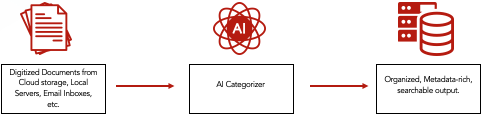
We can scan your documents on site if you don’t want them to leave your office or in bulk at our facility. We take care of all prep (don’t worry about staples!) then meet with your team leaders and determine what storage structure and search requirement suit your needs. Our AI Categorization tool pulls data from the documents and uses that information to sort them in your internal system or a SharePoint creating your desired searchable outcome. ​

AI Categorization

Our AI Categorizer is a document metadata scanning tool that analyzes the scanned documents to extract keywords based on your preferences. It can be configured to use those keywords to rename the document and identify duplicates. It will find metadata (the information about your documents) according to your standards so that it’s easily searchable for future reference. Want all your files from a facility in one place?

Want all your engineering documents identified? That’s what we do. Our quality control team will ensure all rules are clearly established and the output data is correct with a full quality check until our system reports over 99% confidence on the data

Project Workflow

Step 1: Scanning Price

Our team will gather boxes with a courier, label them, remove staples, and format for mass scanning. Once scanning is complete boxes are reassembled as found and shipped back unless instructed otherwise. Output from Step 1 will produce unnamed documents grouped by folder or box and saved on a SharePoint site or external drive. This sets up our team for Step 2. Note that on-site scanning will have custom pricing based on location, document requirements, sizes, file volume, and scanning equipment required

Step 2: Metadata Requirements & Document Renaming

Our team will create your SharePoint structure, define your search criteria, and determine any rules that apply to your business. This will ensure files are organized the way you want them. If your team already has a document management system in place, a bulk upload sheet, and a list of rules for our AI we can waive these one-time setup fees. If we need to create more rules for you, no problem, we can work together on that, standard hourly rates apply.When all physical documents are scanned (Step 1) and the structure and location of the information to collect from the files is set (Step 2), then we are ready to begin sending files through our series of AI tools to pull data from the files.

Step 3: AI Categorization Pricinig

By this stage, our team will understand your needs for this information and how you want to apply it thoroughly, and we can filter it appropriately to reduce costs. We have clients who only want us to fully scan and categorize data through our AI system that are newer than a certain date, a certain file type, or critical files only for example. We have tiered costs for the level of effort involved, as processing files through our full set of AI tools involves processing costs and QC efforts. However, if we have filtering criteria that avoids sending a file for complete processing, we offer that savings back to our clients.

Step 4: Analysis

HAZOP Safety Review and MOC (Management of Change) Compliance Check. Deliverables: P&ID Age & Health Report, HAZOP Gap Analysis, MOC Readiness Score, Digital As-Built Package, Regulatory Compliance Letter.
While this sounds great in theory, the overall cost to the organization will be greater. Hiring, training and managing the intern will take more of your time and yield more error-prone results while also taking more time to complete the job. They won’t have the expertise to name and file each digital document accurately leading to problems down the road.
As part of our multi-step quality control process, all categorized data undergoes subject matter expert review to ensure accuracy and consistency. For example, we have engineers to review engineering documents. Feedback from this stage is used to validate results and loops back into the system as training material, continuously enhancing the categorizer’s performance over time.
From our experience, when a company needs a specific document and doesn’t have a strong system in place already for physical documents they end up reverting multiple people to searching through boxes to find one specific document. This eats up man hours and takes them away from their core work.

Want to get