
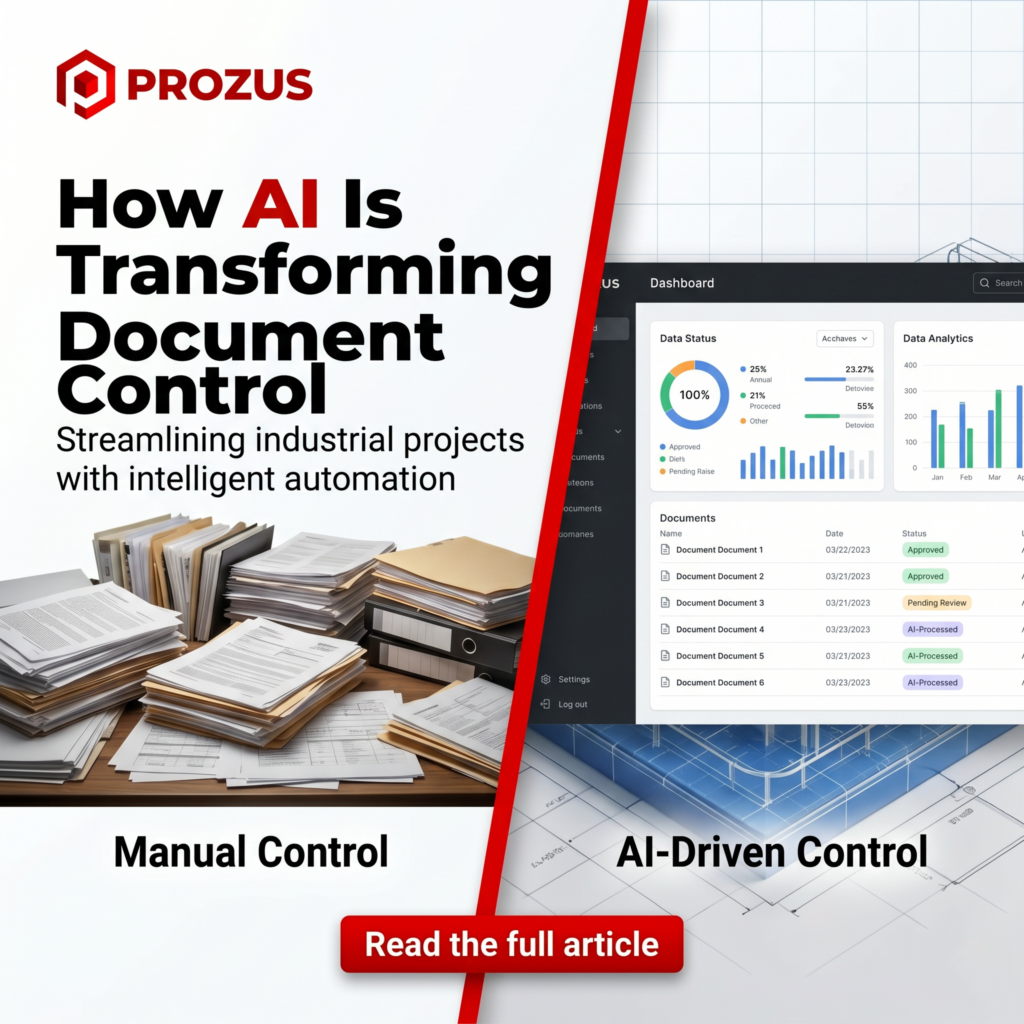
As industrial projects grow in size and complexity, managing engineering documents has become a critical challenge. From drawings and specifications to P&IDs and reports, companies are dealing with massive volumes of data that must remain accurate, accessible, and up to date. Traditional document control methods, often manual and time-consuming, are no longer sufficient. This is where artificial intelligence is transforming how organizations manage and maintain critical project information.
At its core, document control ensures that the right information is available to the right people at the right time. In industrial environments, even small errors, such as outdated drawings or misfiled documents, can lead to costly rework, delays, and safety risks. As a result, companies are increasingly turning to AI-driven solutions to improve accuracy, efficiency, and overall control.
AI enhances document control by automating many of the tasks that were previously handled manually. This includes document classification, data extraction, version tracking, and quality checks. Instead of relying on human input to organize and validate files, AI systems can quickly scan large datasets, identify patterns, and ensure consistency across thousands of documents.
One of the most valuable applications of AI in this space is intelligent document indexing. Engineering files often contain unstructured data, such as text within drawings or scanned PDFs, that is difficult to search using traditional systems. AI can extract and tag this information, making documents searchable and easier to retrieve. This significantly reduces the time engineers and project teams spend looking for critical information.
AI also plays a key role in maintaining data integrity. By continuously analyzing documents, AI systems can detect discrepancies, flag outdated revisions, and identify missing information. This helps ensure that teams are always working from the most current and accurate data, reducing the risk of errors in both design and execution.
A real-world example of this can be seen in Prozus’ work with Inter Pipeline. Faced with a large volume of legacy engineering documents, the client needed a more efficient way to manage, update, and validate their data. By implementing AI-supported document control processes, Prozus was able to streamline document management, improve accessibility, and enhance overall data quality. Check out the full case study here.
Through automation and intelligent workflows, the project reduced manual effort while increasing consistency across thousands of records. Engineering teams were able to quickly locate the information they needed, while built-in validation processes helped ensure accuracy and compliance. The result was a more reliable document control system that supported both ongoing operations and future project work.
Beyond efficiency, AI-driven document control also supports broader project objectives such as regulatory compliance and lifecycle asset management. Accurate and well-maintained documentation is essential for audits, inspections, and long-term facility performance. By leveraging AI, companies can maintain higher standards of data quality while reducing the burden on internal teams.
As industrial projects continue to evolve, the volume and complexity of engineering data will only increase. Companies that rely on manual processes will struggle to keep up, while those that adopt AI-driven solutions will gain a significant competitive advantage.
Prozus helps clients implement intelligent document control solutions that combine engineering expertise with advanced technology. By integrating AI into document workflows, Prozus enables faster access to information, improved accuracy, and more efficient project execution.
In an industry where accurate information is critical, AI is not just improving document control, it is redefining how industrial data is managed, validated, and used to drive better decisions.